 |
| Coco-Pop panna cotta, rice krispie praline, apple, oranges and coffee granita (not pictured, my bad) |
I swear I was not high, nor under the influence of anything unsavory when I came up with this. Nor was I in the depths of 'the day after the night before' whereby the mental filter that would determine whether or not an idea is 'decent, worthy of noting' or 'plain batshit crazy' would be on the blip. No, the most worrying aspect of this post and the recipe it contains is that I was of totally sound mind and body the day I came up with this. The only thing more unsettling than that bit of information is this: the dish itself, it actually kinda rocks.
It started as a simple thought that snowballed into something that became equal parts delicious and demented. Essentially if you were to give it a pretentious synopsis you would say it's a playful deconstruction of breakfast with a sprinkle of nostalgia. It was a Sunday in work and despite the busy night previous I had steamed my way through the prep so found myself in the rare position of not really having that much to do. This is a dangerous thing, you see, the thing about being a chef is that your time pre-service is spent just getting ready for it. So matter how busy or quiet it is, that's all you're focused on, that's all you care about. But with the mental blinkers of preparing for service now removed I look around and, as if for the first time, find myself surrounded by stoves, cookers, equipment and an insanely well-stocked pantry. 'Well-well,' says the culinary Loki on my shoulder, 'whatever shall we get up to now?'
 |
| Seared scallops with beurre 'vert' |
Some interesting stuff has come out of these little sessions. The skin cracker with sous-vide chicken from the last post was the latest. Another was the idea of blending softened butter with spinach to give it a vibrant green colour, when cooled and set, this was then incorporated into a buerre blanc (technically making it a buerre vert) sautéed bacon, peas and herbs were then stirred through. Served with sautéed scallops it was total killer. However not everything has worked out as well. I'm still haunted by The German's face wrinkling in disgust, and then promptly spitting into the nearest bin, my attempt at pickled samphire. However this desert proved to be a step towards redemption.
I was getting a cup of milk from the dispenser in the service area of the kitchen where a majority of the breakfast items are stored. One of these is a multi-drum cereal dispenser. As I stood there drinking my milk and looking at this drum I saw one of the cereals were Coco-Pops. A waft of nostalgia crept through and I remembered that when I was a kid the best part of having a bowl of Coco-Pops for breakfast was finishing the cereal but still having a half-bowl of chocolaty milk with a slight malt flavour left to slurp through. 'Mmm, good times.' I thought and turned to go about the rest of my day. But then I remembered David Chang doing a panna cotta flavored with Corn Flakes, and that was it. As in that moment I realised there was no way I could on living my life without trying this!
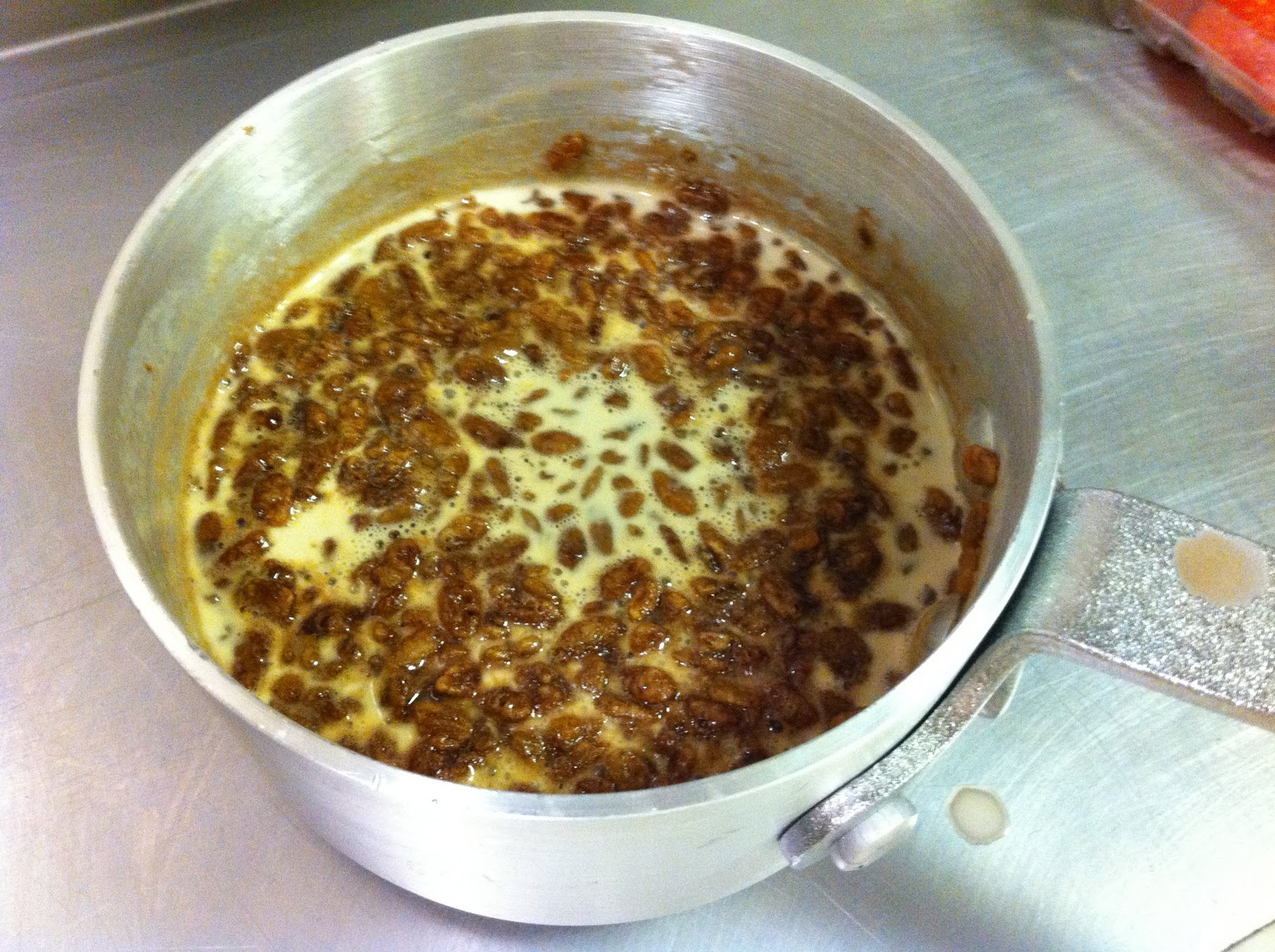 |
| Infusing the milk/cream with Coco-pops |
The result is panna cotta infused with Coco-pops. I then started thinking about what to put with it. The panna cotta is soft and smooth so I knew I needed crunch. So keeping the breakfast cereal theme and I made a Rice Krispie praline. Sweet and sweet, now I need something to brighten it up. I went with two fruits that are commonplace at the breakfast table, oranges and apples. In this case, diced raw apple mixed with some fine orange zest. A line of toffee sauce for decoration and works well with the praline. And finely, when I saw I had a good range of textures I decided I needed a change in temperature, so to thematically bring it full circle a coffee granita. Granita is basically a sorbet that hasn't been churned, think of a dry slushie, or flavored snow.
 |
| Rice Krispie praline cooling |
I got The German to try it, after his initial reaction which was to introduce random drug-testing in the kitchen, he took a spoonful and tasted. Then something happened. Something so rare and fleeting that some would question if it even occurred at all. The bastard actually smiled.
Coco-Pop Panna cotta, Rice Krispie Praline and Coffee Granita (not pictured, my bad)
300ml cream
200ml milk
1 cup approx Coco-pops
2 tbsp sugar
2 leaves gelatin, softened in cold water
100g caster sugar
1/2 cup Rice Krispies
2 cups of lukewarm espresso
30g sugar
- Place the milk and cream in a pot and heat until warm, but do not boil.
- Remove from heat, pour in Coco-pops and stir. Let infuse at room temperature for twenty minutes- one hour.
- Strain well, return to stove and heat again until warm. Add the sugar, squeeze excess water from gelatin and add to pot. Stir to dissolve.
- Pour mixture into desired moulds, place in fridge to set.
- Put sugar with a bit of water in a small pot and place on a high heat.
- Heat until it caramelises to a dark amber colour, remove from heat and stir in Rice Krispies.
- Spoon out onto a tray covered with a layer of baking parchment. Be careful as the mixture is insanely hot. Allow to cool at room temperature.
- Break into pieces and pulse roughly in food processor. Store in airtight container at room temperature.
- Stir sugar until dissolved in coffee.
- Place in small, shallow container and freeze.
- Before serving take a dinner fork and scrape over the mix.
- To serve (as I did anyway but don't take as gospel) sprinkle a line of coco powder on your plate. Draw on two lines of toffee sauce at an angle to this. Remove panna cotta from mould and carefully place onto the line of coco. (mine were pretty stubborn so I had to dip the moulds in hot water, which, while successfully freeing them, started to melt the edges. Hence why the one pictured looks a bit deformed at the end)
- Sprinkle the praline on top of the panna cotta and place the diced apple and orange zest around the plate.
- Finally remove granita from freezer and place a small spoonful to the side.
Quick Notes About Previous Posts
In my last post in which I preached then pros and virtues of sous vide cooking, I banged on about how it allowed uniform doneness when cooking meat. Yet some of you may have noticed how the heading photo which was meant to show it off was taken in a way that didn't really, well, show it off. That's because I was having problems with my meat (and not for the first time) I'd home-vac my steak, put it in and when it'd be done I'd remove, sear and slice it. Yet instead of revealing the sweet-sweet uniform pink I was promised and hoped, I was rewarded with a manky shade of grey. Now while the exterior will always oxidize to a degree, this is unavoidable, having it oxidize internally is unheard of. Numerous searches online revealed nothing. For all intensive purposes this problem has never been encountered. So I varied, well, everything trying to find out what was causing this. From different ways of sealing the bag, to cooking with different liquids in the bag (thought maybe high-acidity fluids like soy or stout was a cause) to no liquids. To the amount of time spent 'under vacuum' all not making that much difference. Less time seemed to lessen it but, you should be able to cook meat indefinitely without any internal oxidization occurring. Otherwise how is Thomas Keller doing 72 hour short-ribs that are cooked medium? So soon after posting he piece I got me some duck breast, et voila! Perfect medium-rare, so what's the craic Jack? Only variable left to explore was the meat itself and then I got my answer. You see, I'm not a rich man by any means (form an orderly queue ladies) so that affects my food shopping. Chicken legs: half price? You bet! Ribeye from questionable sources: 60% off? Count me in! But the thing is, the same thing would happen even with what the supermarkets claimed was 'their finest 21 day aged Angus'. I went into the best butcher I knew, got a striploin that was €10 more per kilo then what I would pay. Bagged and cooked it. In a word S-U-C-C-E-S-S. Finely the €800 egg cooker was doing what it was meant to! Because the places that are using and experimenting with sous vide are generally pretty well-funded and high-end, you can bet their ingredients are equally top notch. Hence, it's not surprising theirs never been the book, 'Sous Vide on a Budget' After all I can't imagine Marcus Wareing getting a KP to run down to Tesco for some back-up lamb chops. But this discovery leads to the unsettling matter, why does this happen to supermarket meat? It's a question I'm sure there's an answer to it, but whether I really want to know is a different matter entirely. Your thoughts people. . . .
 |
| Ribeye steak, cooked for two hours at 56 degrees C. |
What? You didn't know I was on Facebook. Well now you do!


